
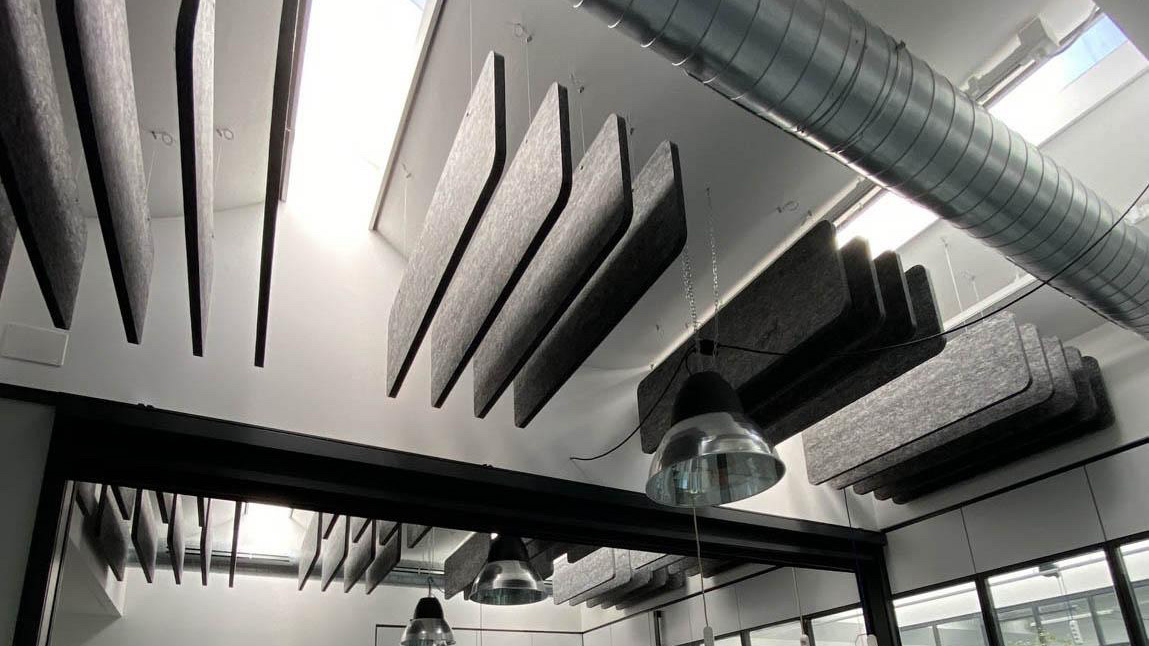
Why an Acoustic Consultant Should Be Part of Engineering Decisions, Not an Afterthought
Acoustic and vibration performance in a building or facility is not something that emerges after construction – it is the direct outcome of decisions made during design: room geometry, isolation system selection, structural stiffness, and equipment placement. When these parameters are not addressed early, the result is a set of measurable outcomes: excessive reverberation time, structure-borne noise, or vibration levels that exceed equipment tolerance. Crucially, these outcomes can also be predicted before construction, through calculation and simulation. For that reason, an acoustic consultant should be involved during the earliest design stages, when acoustic and vibration criteria can still influence room geometry, structural design, and equipment selection at minimal cost.
An acoustic consultant is the professional responsible for making sure that decision is made properly. Yet the term covers a wide range of practice: some consultants focus purely on room acoustics and architectural finishes, others specialize in environmental noise compliance, and a smaller group works at the intersection of acoustics, structural dynamics, and vibration control – the discipline required for critical facilities such as data centers, semiconductor fabrication facilities, and research laboratories.
Understanding what an acoustic consultant actually does, when to bring one into a project, and how to evaluate their capabilities is essential for engineers, architects, facility owners, R&D managers, and procurement decision-makers who must define and validate acoustic and vibration requirements as part of a project’s technical scope.
What Does an Acoustic Consultant Actually Do?
An acoustic consultant is an engineering professional who analyzes, predicts, and designs how sound and, in many cases, vibration behave within and around a building or system. This is distinct from an acoustic contractor or installer, whose role is limited to supplying and fitting acoustic materials according to a specification someone else produced.
A qualified acoustic consultant typically:
- Defines acoustic and vibration performance targets during the design phase, based on the function of the space or facility
- Performs calculations, simulations, and field measurements to verify that a design will meet those targets
- Recommends or designs specific solutions – absorptive treatments, isolation systems, silencers, or structural modifications
- Reviews construction documents and inspects installed work to confirm the design intent is achieved
- Provides continuous vibration monitoring in operating facilities to detect changes in equipment condition or emerging resonance before they cause failures
- Investigates and resolves acoustic or vibration problems in facilities that are already operating
Because acoustics is fundamentally a physics-based discipline, the quality of an acoustic consultant’s work depends heavily on their engineering depth – not only their familiarity with acoustic materials.
Core Service Areas of an Acoustic Consultant
Architectural Acoustics
This is the most visible service area: designing the acoustic character of a room. It includes controlling reverberation time, speech intelligibility, and sound isolation between spaces in concert halls, theaters, offices, classrooms, healthcare facilities, and residential buildings. Architectural acoustics decisions typically involve absorption coefficients, room geometry, and material selection.
Environmental Acoustics
Environmental acoustics addresses noise that crosses property boundaries: from factories, HVAC plants, generators, traffic, or industrial processes toward neighboring buildings and communities. This service area typically involves environmental noise modeling, community noise assessments, and regulatory compliance work, often required as part of planning permits or environmental impact studies.
Noise and Vibration Control in Mechanical Systems
Mechanical and electrical systems – chillers, pumps, generators, HVAC units, elevators – are major sources of both noise and vibration inside buildings. An acoustic consultant working in this area designs silencing systems, selects and specifies vibration isolators, and verifies that mechanical noise will not propagate into occupied spaces as airborne or structure-borne sound.
Where Acoustics Meets Structural Dynamics: The Integrated Approach
Most acoustic consultants stop at the boundary of “airborne sound.” This is a structural limitation of the discipline itself: acoustics as traditionally practiced deals with how sound propagates through air, not with how mechanical energy propagates through a building’s structure. Yet in real facilities, the two problems are physically inseparable – vibration from a chiller or generator becomes structure-borne noise the moment it reaches a floor slab or wall. Addressing one without the other produces incomplete solutions, particularly in data centers, semiconductor fabrication facilities, and research laboratories, where mechanical systems, sensitive equipment, and the building structure itself are in constant dynamic interaction. This gap has created demand for a smaller category of firms that extend their scope into structural dynamics and vibration engineering – the discipline concerned with how mechanical energy travels through a structure, how floors and equipment respond to dynamic loads, and how to prevent resonance before it becomes a problem.
This integrated approach becomes essential in facilities where:
- Vibration-sensitive equipment must be isolated using spring-damper isolation systems, floating slabs, or engineered pedestal design
- Seismic events must not interrupt operations, requiring vibration isolation and seismic control engineered together rather than as separate disciplines
- Cable and piping runs need dedicated cable mount solutions to prevent vibration transmission through building services
- Continuous operation is a business requirement, calling for functional continuity and seismic control as a single design objective rather than a checkbox exercise
For semiconductor fabrication facilities, microelectronic FAB vibration control, and special and nano buildings vibration control, this integration is not optional – it is the core engineering challenge.
When Do You Need an Acoustic Consultant?
Early involvement of an acoustic consultant is primarily a matter of engineering influence, not only cost. Acoustic and vibration criteria are far easier to incorporate while structural design, equipment layout, and building services are still open to change; once construction is complete, the same corrections often require intrusive retrofits. In operating facilities such as data centers and laboratories, this becomes a scheduling and continuity issue as much as a technical one, since corrective work may require downtime the facility cannot easily absorb. The following scenarios typically call for professional acoustic consulting:
- New building or renovation design stage. Acoustic and vibration criteria should be set alongside architectural and structural design, not added afterward. Retrofitting isolation or absorption into a completed building is far more disruptive and costly.
- Noise complaints or regulatory pressure. When neighbors, tenants, or regulators raise noise concerns, an acoustic consultant can quantify the problem with field measurements and propose a defensible, engineered solution.
- Installation of vibration-sensitive equipment. Electron microscopes, lithography tools, precision manufacturing lines, and research instrumentation often have strict vibration tolerance limits that must be verified before installation, not after a tool fails to qualify.
- Data centers and critical infrastructure. Cooling equipment, generators, and UPS systems generate broadband vibration and structure-borne noise that can affect both surrounding occupants and the reliability of the facility itself.
- Performance or occupancy validation. Before a concert hall, laboratory, or manufacturing floor is handed over, measurements should confirm that the acoustic and vibration environment matches the design intent.
- Ongoing monitoring in critical facilities. Continuous vibration monitoring during operation allows early detection of drift in mechanical condition or emerging resonance issues before they cause equipment failures.
Engineering Tools and Methodologies Used by Acoustic Consultants
A consultant’s toolbox reveals a great deal about their engineering depth. Common methods include:
- Finite element analysis to simulate the dynamic and acoustic response of structures, equipment bases, and enclosures before anything is built
- Anechoic chamber and anechoic room testing for precise measurement of sound power, radiated noise, and material performance under controlled, reflection-free conditions
- Field measurements of noise and vibration at occupied sites, used both for diagnosis and for validating simulation results against real-world behavior
- Vibration monitoring – including continuous vibration monitoring with automated alerts – for facilities where equipment condition or seismic events need to be tracked over time rather than checked once
- Room and environmental acoustic modeling software – such as Odeon for three-dimensional room acoustic simulation and SoundPLAN for environmental noise propagation – to predict reverberation, speech intelligibility, and community noise impact before construction
Consultants who combine simulation, in-house laboratory testing, and field measurement capability can validate their designs at every stage, rather than relying on published data sheets that may not reflect actual installation conditions.
Acoustic Consulting for Critical and High-Tech Facilities
Data centers, semiconductor fabrication facilities, and research laboratories represent the most demanding end of acoustic and vibration engineering. In these environments, the consultant’s task extends well beyond comfort or compliance – it directly affects equipment reliability and business continuity.
Typical challenges include vibration transmitted from chillers, cooling towers, and generators into structural floors and racks; the need for data center vibration isolation and data center seismic control to be designed as a single system rather than isolated fixes; and the extremely tight tolerances required for microelectronic FAB vibration control, where even micro vibrations below the threshold of human perception can affect yield.
How to Choose the Right Acoustic Consultant
Not every acoustic consultant is equipped for every project. When evaluating candidates, consider:
- Engineering background, not just acoustic material knowledge – degrees and experience in mechanical or structural engineering indicate a deeper analytical capability
- In-house laboratory and testing facilities, such as anechoic chambers and reverberation rooms, which allow independent verification rather than reliance on third-party data alone
- Simulation capability, particularly finite element analysis, to validate designs before construction
- Track record with critical facilities such as data centers, semiconductor fabrication facilities, or research laboratories, where the margin for error is small
- Ability to design and manufacture custom solutions – spring-damper isolation systems, pedestal design, and cable mounts – rather than only specifying off-the-shelf products
- Multidisciplinary integration between acoustics, structural dynamics, and seismic engineering, so vibration and noise are solved as one coordinated system
Acoustic Consultant vs. Integrated Acoustics-and-Dynamics Engineering Firm
| Capability | Generalist Acoustic Consultant | Integrated Acoustics & Structural Dynamics Firm |
|---|---|---|
| Room acoustics and absorption design | Yes | Yes |
| Environmental noise compliance | Yes | Yes |
| Mechanical noise and vibration isolation | Often limited to specification | Engineered and validated in-house |
| Seismic and functional continuity design | Rarely in scope | Core competency |
| Finite element analysis of structures | Rarely in-house | In-house capability |
| In-house labs (anechoic chamber, reverberation room) | Varies | Typically available |
| Vibration-sensitive facility experience (semiconductor fabrication facilities, data centers) | Limited | Core specialization |
| Custom manufacturing of isolation solutions | Rarely | Available |
Frequently Asked Questions About Acoustic Consultants
What is the difference between an acoustic consultant and an acoustic engineer?
In practice the terms are often used interchangeably. “Acoustic consultant” typically emphasizes the advisory and design role on a project, while “acoustic engineer” may emphasize the underlying technical qualification. The scope of work is usually the same.
At what project scale does acoustic consulting become necessary rather than optional?
Acoustic consulting becomes necessary once a project involves noise-sensitive occupants, regulatory noise limits, vibration-sensitive equipment, or mechanical systems capable of generating structure-borne noise. Below that threshold, acoustic input may still improve outcomes but is not typically mission-critical.
Can an acoustic consultant also solve vibration problems, not just noise?
Many acoustic consultants focus only on airborne sound. Vibration problems – particularly those involving structural response, seismic performance, or vibration-sensitive equipment – require a consultant with structural dynamics expertise, not acoustics alone.
When should an acoustic consultant be brought into a project?
As early as possible – ideally during conceptual design, when acoustic and vibration criteria can still influence layout, structural design, and mechanical system selection before those decisions are finalized. When acoustic and vibration requirements are addressed only after construction or installation, the same corrections typically require structural modification, equipment relocation, or production downtime – interventions that are inherently more disruptive than decisions made on paper during design.
Is acoustic consulting relevant for data centers and semiconductor fabrication facilities?
Yes. These facilities combine strict vibration tolerances for sensitive equipment with significant noise and vibration sources from cooling and power systems, making integrated acoustic and vibration engineering essential rather than optional.
What is the role of an acoustic consultant in seismic design?
Where seismic events must not interrupt operations, an acoustic consultant with structural dynamics expertise can integrate vibration isolation and seismic control into a single engineered system, rather than treating them as separate requirements addressed by different teams.
How is acoustic consulting different from acoustic testing or certification?
Testing and certification verify that a completed installation meets a standard. Consulting covers the full lifecycle – defining requirements, designing the solution, and then validating it through testing and measurement.
Dynamica Design: An Acoustic Consultant Built on Structural Dynamics Expertise
Dynamica Design brings together acoustic consulting and structural dynamics engineering under one roof – a combination that most acoustic consultancies do not offer. With over 40 years of experience and in-house departments covering engineering R&D, dynamics and analysis, multi-physics simulation, acoustics, and measurement laboratories, Dynamica evaluates noise and vibration as parts of the same engineering problem rather than as separate specialties handled by different vendors.
This integration is particularly valuable for clients managing critical and high-tech facilities – data centers, semiconductor fabrication facilities, and research infrastructure requiring special and nano buildings vibration control – where equipment reliability depends on functional continuity and seismic control being engineered together with day-to-day noise and vibration performance. Dynamica’s in-house laboratories, including anechoic chambers, anechoic rooms, and reverberation facilities, combined with finite element analysis and field measurement capability, allow designs to be validated at every stage rather than assumed.
For engineers, architects, R&D managers, and procurement decision-makers evaluating acoustic consultants for a demanding project, the key evaluation criterion is whether the consultant can address noise, vibration, and seismic performance as a single coordinated engineering problem, rather than as separate scopes handled by different specialists.
Recent Projects